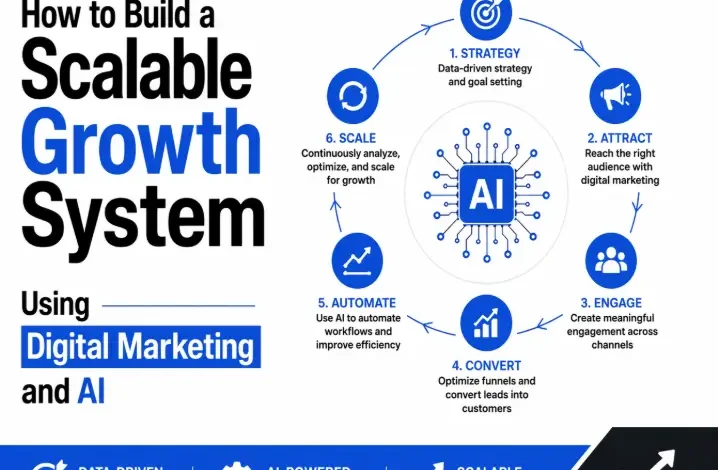
Every business owner wants to grow. But not all growth is equal. There is a big difference between growth that is fragile and growth that is scalable and sustainable.
Scalable growth means your business can get bigger without everything breaking. Your marketing can reach more people without you having to do ten times the work.
Building this kind of system requires two things: a solid digital marketing foundation and the smart use of AI tools to automate and improve at every stage.
In today’s market, businesses that are using AI-driven marketing systems are outgrowing those that are doing everything manually.
Muhammad Eassa is a Digital Marketing Consultant who helps businesses do exactly this. He builds the right strategy, creates systems for predictable business growth, and integrates AI to make the whole process more efficient and scalable.
Whether you are just starting out or looking to grow beyond your current ceiling, this guide covers the core principles of scalable marketing.
What Is a Scalable Growth System?
It Works Without You Running Everything
A true growth system does not depend on you being involved in every task. Parts of it run automatically. Content gets published, ads run, emails get sent, leads get followed up, all without you needing to press every button.
It Gets Better Over Time
A scalable system is designed to improve. Every piece of data feeds back into the system and makes future decisions smarter. You learn what works, you do more of it, and results compound.
It Can Handle More Volume
As your business grows, your marketing should be able to reach more people without requiring a proportional increase in budget or team size. This is what scalability really means.
The Core Building Blocks
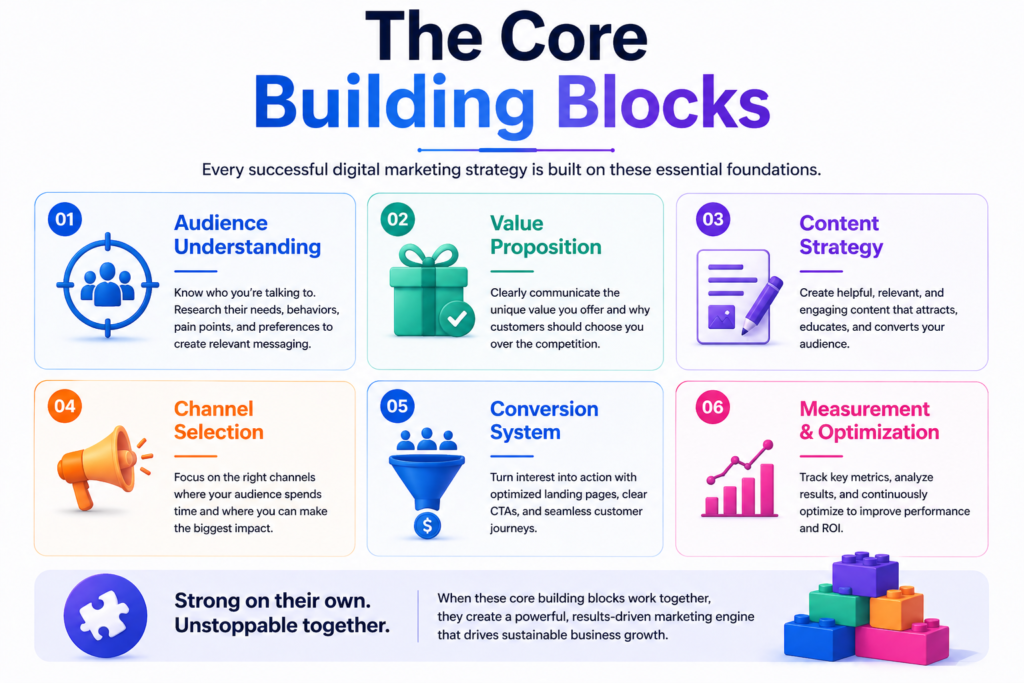
Block 1: A Clear Brand Message
Before anything else, you need a clear and consistent message. Who are you? Who do you help? What results do you deliver? This message should be the same everywhere your business appears online.
Without a clear message, even the best marketing system will confuse people instead of converting them.
Block 2: A High-Converting Website
Your website is the center of your marketing system. Everything else drives traffic back to it. Make sure your website clearly explains what you do, who you help, and how to get started.
A website that converts well can dramatically improve the return from all your other marketing efforts without increasing your spending.
Block 3: Organic Content and SEO
Content and SEO form the long-term foundation of your marketing system. They build your authority, improve your search rankings, and bring in free traffic that keeps coming even when you are not actively pushing it.
The key is consistent production. One blog post per week over a year creates a huge library of content that works for your business around the clock.
Block 4: Paid Traffic and Lead Generation
Paid advertising gives your system a reliable and controllable way to bring in new leads. When set up correctly, you can spend a set amount and predictably receive a certain number of leads in return.
This predictability is what makes it a key part of a scalable system.
Block 5: Email and Nurture Sequences
Not everyone is ready to buy the moment they discover your business. An email nurture system keeps them engaged over time and guides them toward a purchase when they are ready.
Automated email sequences can handle this process without any manual effort on your part.
Block 6: Analytics and Reporting
You cannot improve what you don’t measure. A proper analytics setup tells you where your leads are coming from, which content is performing, where people are dropping off, and how much revenue each marketing channel is generating.
Where AI Fits Into the System
AI for Content Creation
AI writing tools can help you produce more content faster. Blog posts, social media captions, email newsletters, and ad copy can all be drafted much more quickly with AI assistance.
The key is not to let AI replace your thinking, but to use it to speed up the work of putting your thinking into words.
AI for Ad Optimization
Modern advertising platforms use AI to automatically optimize your campaigns. They test different audiences, ad formats, and budget allocations to find the most efficient combination.
Consultants like Muhammad Eassa layer their own expertise on top of these tools to push results even further.
AI for Customer Insights
AI analytics tools can identify patterns in your customer data that would take a human analyst much longer to find. Which customers are most likely to buy again? Which segments convert at the highest rate? AI can answer these questions quickly.
AI for Automation
From chatbot responses to automated email triggers to social media scheduling, AI-powered automation handles many of the repetitive tasks that would otherwise eat up hours of your team’s time.
See also: Sogou Input Method: Smart Typing Technology Redefining Chinese Language Input
How to Start Building Your Growth System
Start With the Foundation
Don’t try to automate things before they work. Get your message right, your website converting, and your core channel producing results before adding complexity.
Add One Block at a Time
Build your system gradually. Start with content and SEO or paid ads. Then add email nurturing. Then add automation. Each block should be working before you add the next one.
Use AI to Multiply What Works
Once a channel or tactic is producing results, use AI to do more of it faster. AI is most effective when applied to things that are already working, not as a shortcut to skip the hard work of figuring out what works.
Review and Improve Regularly
Set a monthly review where you look at all your numbers and decide what to improve, what to stop, and what to scale. This review process is what turns a good system into a great one over time.
Common Mistakes When Building a Growth System
Building Before the Foundation Is Ready
Many businesses rush to automation before their core message and offer is even clear. Automating a broken process just spreads the problem faster. Fix the foundation first.
Using Too Many Tools
There are hundreds of marketing tools available. Using too many creates confusion and complexity. Pick a small number of high-quality tools and learn them deeply.
Not Measuring the Right Things
Focus on metrics that connect to revenue and growth. Traffic, followers, and open rates are useful, but they are not the full picture. Revenue generated per channel and customer acquisition cost are the numbers that matter most.
Final Thoughts
Building a scalable growth system is one of the best investments a business can make. Once it is running, it generates leads and customers consistently without requiring all your time and attention.
Start with a strong foundation, add each block deliberately, and use AI to scale what works. That is the formula for scalable, sustainable growth.