Industrial Automation30% Cost Savings A New Strategy for Custom Gear Production in SMEs

Introduction
The global manufacturing landscape is intensifying, placing immense pressure on small and medium-sized enterprises . Customer demand is increasingly personalized, calling for low-volume, high-mix Custom Part Production. However, transforming traditional, scaled production lines is daunting, leading to protracted lead times, high costs, and continuously shrinking profit margins.The core issue is that while many companies recognize the need to upgrade, the complexity of Industrial Automation Solutions leaves them unsure where to start. This is especially true for high-precision applications like Custom Gear Machining, where building an in-house automated line requires prohibitive investment and technical expertise, causing many firms to hesitate.
This article will provide a deep dive into how SMEs can integrate external, specialized CNC Machining Services and automated processes—focusing particularly on the critical link of CNC gear manufacturing—to achieve a leap in production efficiency and quality with manageable investment. The following five key questions will reveal a clear implementation path.
Why are Precision Gears the Joints and Bottlenecks of Modern Industrial Automation Systems?
Precision gears act as the “physiological joints” of automation systems. Their performance directly dictates the agility, power, and accuracy of the entire machine. In robotic joints, gear pairs convert motor rotation into precise end-effector movement, where backlash and transmission errors are magnified, affecting final positioning accuracy. On automated conveyor lines, the efficiency and durability of gearboxes determine line cycle times and mean time between failures. A single micro-gear failure can halt a multi-million dollar production line.
The International Society of Manufacturing Engineers (SME), in its report on advanced manufacturing trends, explicitly identifies “integrated precision drive systems” as key to enhancing the performance, reliability, and energy efficiency of automated equipment. This means that a superior Industrial Automation Solutions package is fundamentally dependent on near-perfect power transmission. Consequently, the gear manufacturing process—from material selection and tooth profiling to heat treatment—becomes the dividing line between ordinary part fabrication and high-reliability automation solutions. It is not merely a physical connector but a critical performance bottleneck.
What Unique Challenges and Automation Opportunities Do SMEs Face in Custom Gear Production?
For SMEs, venturing into custom gear production means confronting a series of significant challenges, but it also presents opportunities for breakthrough through specialized collaboration.
Challenge 1: The Cost and Efficiency Dilemma of Low Volume, High Mix
Traditional mass gear production relies on dedicated machines and tooling, with extremely high changeover costs. SME orders are often characterized by small batches and frequent specification changes. Constant line retooling cripples efficiency and drives per-part costs up, making Custom Gear Machining seem “uneconomical” on paper.
The Deep Waters of Material and Heat Treatment
Gear performance depends not only on tooth form but also on materials science and heat treatment. Expertise in areas like case depth and hardness gradient can be a blind spot, leading to products that fail to meet lifespan expectations.
The High Cost of Metrology
Gear accuracy inspection requires expensive specialized equipment like coordinate measuring machines (CMMs) and gear testers. Building an in-house lab is a major capital expenditure, while relying on outsourced inspection leads to long feedback cycles and passive quality control.
Opportunity: The Flexible Automation Advantage of Specialized Providers
This is precisely where the value of professional Custom Gear Machining service providers lies. With flexible automated production lines and extensive process databases built for serving diverse industries, they can turn these challenges into advantages. Companies can access top-tier manufacturing capabilities without heavy capital investment, converting fixed costs into variable costs and responding swiftly to the market. To explore the wide-ranging applications of custom gears, read this industry analysis on custom made gear.
The Four-Step Strategy for Automation Transformation Starting with Gears and a Realistic Cost Analysis
For SMEs committed to upgrading, beginning with CNC gear manufacturing offers a pragmatic and efficient pathway. A recommended strategy involves outsourcing the most complex gear production to a specialized CNC Machining Services provider. This enables rapid access to high-quality components, accelerating time-to-market. Companies should then engage in collaborative Design for Manufacturability (DFM) with the supplier to optimize designs for automated assembly, while focusing internal resources on core system integration and final testing.
Finally, leveraging the stable quality data from the outsourced parts for design iteration creates a continuous improvement cycle. Analysis from MAPI on “targeted automation” ROI indicates this “outsource + integrate” model can cut initial investment by over 60% and nearly halve the payback period compared to building a full in-house line, allowing firms to leverage top-tier processes with controlled cash flow.
How to Identify and Evaluate a Reliable Precision Gear and Part Manufacturing Partner?
Choosing the right partner is half the strategic battle. Here is a key supplier evaluation checklist:
Evaluate End-to-End Technical Capability
Does the supplier possess full-process capability from gear design and the gear manufacturing process to complete Custom Part Production? This determines if they can provide a one-stop solution, avoiding the complexity and risk of coordinating between multiple vendors.
Assessing Technical Capability and Process Depth
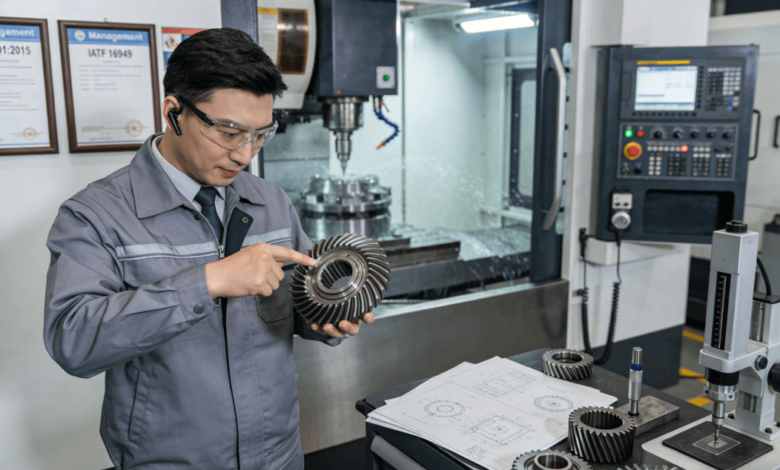
A thorough technical evaluation is crucial. First, verify the supplier holds authoritative certifications like ISO 9001, and industry-specific ones such as IATF 16949 or AS9100D, which are hard evidence of rigorous quality systems. Beyond paperwork, scrutinize their physical and technical assets to ensure capability matches promise.
Scrutinize Core Equipment and Certifications
Assess the machine tools underpinning their CNC Machining Services. Request details on brands, models, capabilities, and maintenance. The presence of multi-axis CNC and dedicated gear machining centers signals a commitment to advanced, precise manufacturing, directly supporting their certified quality claims.
Probe Specific Process Expertise
Move beyond generalities. Deep-dive into their specific protocols and case studies for critical processes like heat treatment (carburizing, nitriding) and finishing (gear grinding, honing). Proven, documented expertise in these areas is the true differentiator for a precision machining gears partner.
See also: Sogou Input Method: Smart Typing Technology Redefining Chinese Language Input
Beyond One-Time Procurement: A Success Case of Transforming a Gear Supplier into an Automation Strategic Partner
Successful transforming companies view their gear suppliers as an integral part of their automation competitiveness. For instance, a mid-sized industrial robot manufacturer, developing a new generation of high-precision robotic arms, faced bottlenecks in joint gear lifespan and noise. Instead of tackling this in-house, they entrusted the core reducer gear’s industrial gear manufacturing entirely to a precision manufacturing partner holding both IATF 16949 and AS9100D certifications.
The two parties formed a joint engineering team from the conceptual design stage. Leveraging its material database and simulation capabilities, the supplier optimized the gear’s profile modification and heat treatment parameters. The result was a 15% improvement in the robot’s repeatability positioning accuracy, a significant increase in mean time between failures, and notably reduced noise. This gave the company’s robots a powerful differentiated competitive edge in the market, and its Industrial Automation Solutions gained favor with high-end clients due to exceptional reliability and precision. This case demonstrates that deep collaboration with a specialized partner represents a strategic shift from viewing procurement as a “cost center” to “gaining a competitive advantage.”
Conclusion
For SMEs seeking a breakthrough, entrusting high-precision processes like Custom Gear Machining to specialized, fully-certified external partners is not a simple business outsourcing move, but a strategic decision. It allows for the rapid integration of top-tier CNC Machining Services and process knowledge with controlled risk and investment, serving as a highly efficient path to building competitive Industrial Automation Solutions.
If you are searching for a reliable precision gear and part manufacturing solution for your next-generation product and desire a partner with consistency and traceability from design collaboration to volume production, the engineering team at CNC Protolabs can provide a professional assessment. Inquire now to receive an optimized proposal for your project.
Author Bio
This article was written by Alex Techton, a seasoned SEO content strategist focused on digital transformation in manufacturing and supply chain efficiency, with over a decade of experience providing digital marketing solutions for industrial B2B enterprises.
FAQs
Q1: For small-batch custom gears, can automated production truly reduce costs?
A:Yes. Professional suppliers’ flexible automation cells are designed for rapid changeovers, significantly reducing setup and idle time in single-piece production, thereby lowering the comprehensive cost of small-batch orders, offering better economics compared to building in-house lines or using outdated equipment.
Q2: What level of gear accuracy can be achieved through outsourcing?
A:Leading suppliers can consistently achieve DIN 6-7 grades, with key components reaching DIN 4-5 grades after process optimization, meeting the vast majority of industrial automation and precision drive needs. Specific accuracy depends on material, heat treatment, and final application.
Q3: What do IATF 16949 and AS9100D certifications mean for a gear supplier?
A:These are top-tier quality system certifications for the automotive and aerospace industries, signifying that the supplier meets the highest standards in process control, traceability, and risk management. Choosing such a supplier significantly reduces your quality risk and supply chain uncertainty.
Q4: If my product requires various custom parts, not just gears, can it be a one-stop solution?
A:Absolutely. Leading precision manufacturing service providers typically offer comprehensive Custom Part Production capabilities from CNC Machining Services, injection molding to sheet metal fabrication, ensuring all parts are coordinated in tolerance, standards, and delivery, simplifying your supply chain management.
Q5: Typically, how long does it take from inquiry to receiving the first prototype gear samples?
A:The cycle depends on complexity. For moderately complex gears, professional rapid-response services can deliver the first functional prototypes within 2-4 weeks. In-depth upfront DFM (Design for Manufacturability) analysis is key to ensuring first-time success and shortening the overall cycle.